Monday, May 5, 2003
Venezuela's Chavez decrees sharp minimum wage hike
Reuters, 04.30.03, 3:07 PM ET
CARACAS, Venezuela, April 30 (Reuters) - Venezuela's President Hugo Chavez, whose leftist government is struggling to overcome a harsh recession and a fiscal shortfall, on Wednesday decreed a 10-percent hike in minimum wages from July and another sharp 20 percent increase from October.
"The increase of 10 percent will start from July 1," Chavez told an audience during a workers award ceremony.
Chavez, a populist elected in 1998, is presiding over an oil-rich economy in steep decline. His government has already implemented strict currency and price controls that private sector leaders say have worsened the nation's economic crisis by starving businesses of dollars for more than three months.
US democracy expert teaches Venezuelan opposition
By Pascal Fletcher
CARACAS, Venezuela, April 30 (Reuters-alertnet.org) - Retired U.S. army colonel Robert Helvey has trained pro-democracy activists in several parts of the world so he knows something about taking on military regimes and political strongmen.
Now he is imparting his skills in Venezuela, invited by opponents of President Hugo Chavez who accuse the leftist leader of ruling like a dictator in the world's No. 5 oil exporter.
Helvey, who has taught young activists in Myanmar and Serbian students who helped topple the former Yugoslav leader Slobodan Milosevic in 2000, is giving courses on non-violent opposition tactics this week at an east Caracas university.
Secrecy surrounds the classes. A sign outside the door, apparently there to deflect the curious, reads: "Seminar on strategic marketing".
But the strategies Helvey is sharing with some of Chavez's foes focuses not on balance sheets but on how to resist, oppose and change a government without the use of bombs and bullets.
After initially declining to answer questions, Helvey, a former U.S. military attache in Burma and now a consultant with the private U.S. Albert Einstein Institution that promotes non-violent action in conflicts, told Reuters non-violence was the key to the tactics he taught.
"In every political conflict, there is a potential for violence, and it is incumbent on leaders to make sure they don't cross the threshold of violence," he said.
Organizers of the seminar did not welcome journalists. "This is a private meeting of friends", one said.
The attendees included representatives of Venezuela's broad-based but fragmented opposition, who are struggling to regroup after failing to force Chavez from office in an anti-government strike in December and January.
Chavez, a fiery populist first elected in 1998, survived a brief coup last year by dissident military officers who now form part of the opposition movement, which also includes labor and business chiefs, politicians and anti-Chavez civic groups.
CHAVEZ, DEMOCRAT OR DICTATOR?
Opposition sources said Helvey was invited to Caracas by a group of businessmen and professionals. They in turn organized the course involving a broad cross-section of the opposition.
Helvey's presence comes at a time when a debate is raging inside and outside Venezuela about whether Chavez is a democrat or a power-hungry autocrat. That debate is important for the United States, which is a major buyer of Venezuelan oil.
Chavez's critics portray him as a dangerous, anti-U.S. maverick who has extended his personal political control of the country's political institutions, judiciary and armed forces.
They say he has strengthened his country's ties with anti-U.S. states like communist Cuba, Iran, Libya and -- until the U.S.-led invasion toppled Saddam Hussein -- Iraq.
Since the April 2002 coup that briefly overthrew him, Chavez's relations with the United States have remained edgy. The U.S. government has fiercely denied accusations from some Venezuelan officials that it encouraged or supported the coup.
Chavez fiercely condemned the invasion of Iraq. But Venezuelan oil shipments to the U.S. have kept on flowing.
The Venezuelan leader, who was elected to office six years after failing to seize power in a botched coup, denies he is a communist, says his government is democratic and regularly pillories his opponents as "terrorists" and "coup-mongers".
His foes have staged huge, anti-Chavez street protests over the last 18 months. He portrays them as a wealthy, resentful elite opposed to his self-styled "revolution" which he says aims to benefit the oil-rich nation's poor majority.
Neither Helvey nor the organizers of the Caracas seminar would give details of exactly what opposition tactics were being taught. But in his work in Serbia before Milosevic's fall, Helvey briefed students on ways to organize a strike and on how to undermine the authority of a dictatorial regime.
In the mid 1990s, he traveled to the Thailand/Myanmar border to give classes in non-violent resistance to exiled Burmese students opposing the military junta in their country.
His former students remember him as "Bob".
"He used his military skills in strategic planning for non-violent protest methods ... Everybody was fascinated by Bob, because he was a military man and was applying that to non-violence," Aung Naing Oo, former foreign secretary for the All Burma Students Democratic Front, told Reuters.
A spokesman for the U.S. Embassy in Caracas told Reuters the embassy knew nothing about Helvey's visit and had nothing to do with the secretive seminar. (Additional reporting by Dan Eaton)
Diamonds have oceanic origin, says University of Toronto geologist
Public release date: 30-Apr-2003
Contact: Lanna Crucefix
lanna.crucefix@utoronto.ca
416-978-0260
University of Toronto
The black spots on the image show some of the inclusions of coesite and other minerals. The actual sample is approximately 2 mm in diameter and was captured through cathodoluminescence, a high-resolution imaging technique. It's called the 'Picasso' diamond because of its cubist appearance.
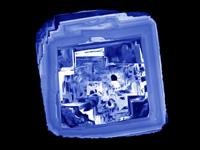 Credit image to Schulze et. al.
Full size image available through contact
More than just symbols of wealth and beauty, diamonds are a testament to the history of the earth, says University of Toronto professor Daniel Schulze.
Schulze, a professor in the Department of Geology at the University of Toronto at Mississauga, believes that the materials that form the gem diamonds mined in Guaniamo, Venezuela, originated on the ocean floor and has found hard evidence that supports this controversial theory. The study is published in the May 1 issue of Nature.
The diamond formation process begins, Schulze explains, when the mantle - the interior layer between the earth's core and its crust - forces lava up onto the ocean's floor. The lava then solidifies into a volcanic rock called basalt. When the basalt interacts with sea water, its oxygen composition changes. "The volcanic rocks are altered to form new minerals. It's like the steel in your bicycle changing to rust in the rain," he says.
Geological processes then thrust this altered basalt under the earth's continental plates where heat and pressure turn the basalt into eclogite - beautiful red and green rocks that may contain diamonds, if carbon is present. Over time, as the eclogite remains in the mantle, it eventually takes on the oxygen composition found in this environment. "This process can erase or modify past evidence of the ecolgite's oceanic origins," says Schulze. "But because diamonds [contained within the eclogite] are impermeable, they act as 'time capsules,' preserving inside themselves a record of conditions that existed during diamond formation."
In his study, Schulze and his team developed a new procedure using an ion microprobe to analyze tiny minerals, called coesite, in the diamonds. They compared these minerals to those in ocean-altered basalts and mantle eclogite, finding the coesite's oxygen composition a close match to that of the altered basalt, rather than the eclogite. "This proves these diamonds have an oceanic heritage," he says.
This analysis also explains why mantle eclogites have an unusual oxygen composition compared to the surrounding mantle. "Although, over time, the eclogite assumes most of the mantle's oxygen characteristics, it may not have completely lost the oxygen composition it inherited as ocean-altered basalt," says Schulze.
In addition, these particular diamonds, he says, seem to have "biogenic" carbon signatures, indicating that some of the carbon that formed the diamonds originally was living, such as ancient sea floor bacteria. "Attached to the altered basalts, this carbon would have, in essence, gone along for the ride as the rock was thrust under the continents." Heat and pressure would have turned the organic carbon into pure carbon in the form of graphite and, then finally, into diamond.
Studying diamonds is one of the only ways scientists can learn not only about what is found deep beneath the earth's crust but the history of the early earth and environmental conditions when the diamonds were formed. "These tiny time capsules have indeed provided the 'missing link' between the mantle and the crust."
Funding for this study was provided by the Natural Sciences and Engineering Research Council of Canada and the National Science Foundation.
CONTACT:
Lanna Crucefix
U of T Public Affairs
416-978-0260
lanna.crucefix@utoronto.ca
Daniel Schulze
UTM Department of Geology
905-828-3970
dschulze@utm.utoronto.ca
Venezuelan youngster battles cash crisis
DAVID THORPE, <a href=www.edp24.co.uk>EDP SPORTS EDITOR
April 30, 2003 17:11
Rodolfo Gonzalez, the Venezuelan who moved to Norfolk when he was 10 years old to pursue his dream of motorsport stardom, has had to delay his step up to the main Formula Ford championship – because of a financial crisis back home in South America.
Now 16, Gonzalez is already an established celebrity in Venezuela, having already won several sporting awards for his achievements in karting on foreign fields.
In the Formula Ford Southern Zetec Championship last year Gonzalez – the youngest competitor in the field - did enough to prove to Snetterton-based Continental Racing that he would be ready to represent them in the senior version of the event.
But two weeks before the campaign opener at Mondello Park he received a bombshell which threatened to scupper his whole season.
The collapse of the Venezuelan petrol industry, which is responsible for around 80pc of the country's export earnings, had a devastating knock-on effect to a teenager living in Attleborough.
His main sponsor, petrol giants PDV, not only found themselves with different priorities – having laid off 16,000 workers - but were barred from exporting currency abroad.
Several weeks and an Atlantic crossing later, however, Gonzalez and his father, Carlos, have managed to get in place some alternative backing which will enable him to resume his attempt to follow in the footsteps of another South American who came to Norfolk to make his name - Brazilian Ayrton Senna – when the championship goes to at Silverstone on May 26.
By then he will have celebrated his 17th birthday, on May 14, and missed six of the 20 championship rounds.
"I have had to write off the first three meetings," said the former Eccles Hall schoolboy. "But I will hopefully be able to do the other seven, which are all double headers, as well as the Southern Championship, which is smaller but will be good experience.
"I will go with the team to Brands this weekend to help out where I can and should start testing next week.
"We have been going all over Venezuela trying to get people to back me. Nobody said no but it is now a much longer process because the economy there is so out of control.
"I have been in England for six years and I'm not going to give up now. But I believe that if I can survive this year then 2004 should be a whole lot easier."
The struggle goes on for former South American F3 driver Carlos, who returns to Caracas this weekend in an attempt to tie up a few more loose ends while his son is in Kent with the Continental team.
But he insists: "It has been like a football match where your team is 3-0 down with ten minutes left. You still think your team can win - but you know it's going to be tough."
CICPC: checkered history of alleged Plaza Altamira triple murderer
<a href=www.vheadline.com>Venezuela's Electronic News
Posted: Wednesday, April 30, 2003
By: Patrick J. O'Donoghue
Police Detective Branch (CICPC) have captured Tairo Robinson Aristiguieta Ramirez, whom the surviving victim of the 4 Altamira murders recognized as the person, who nearly killed her. According to TalCual evening tabloid, Aristiguieta Ramirez, who was one of the rebel military officers' security guards around Plaza Francia, has a long criminal rap.
The tabloid claims that Aristiguieta Ramirez was implicated in the famous 80s Mamera case in which a Metropolitan Police (PM) officer killed three youths in an Antimano barrio slum out of jealously.
A police investigation concluded that Aristigueto Ramirez ... Ledesma's buddy ... was not implicated in the crime, despite a witness insisting that he had acted as accomplice in disposing one of the bodies along the Cota 905 highway.
Later, Aristiguieta Ramirez was dismissed from the force for indiscipline and corruption, starting a security firm specializing in providing bouncers and security for night clubs and bars, as well as private detective work.
In the 90s the former police officer was linked to the death of a storekeeper, who allegedly hired someone to kill his son ... he spent several years in Catia and la Planta prisons.
- At the end of 2002, Aristiguieta Ramirez surfaces as one of the Altamira Plaza security chiefs.
- On February 5, his brother is shot in a shootout with the police, who accused him of belonging to a gang of car thieves.
- A week later, the brother's parents accuse the police of executing their son ... a week later, the three soldiers who had joined the rebel military commanders, are murdered allegedly as members of the gang.