Friday, February 7, 2003
Finance Minister to set single exchange rate
www.vheadline.com
Posted: Wednesday, February 05, 2003 - 2:35:30 AM
By: Robert Rudnicki
Finance (Hacienda) Minister Tobias Nobrega is set to announce a new exchange rate control system tomorrow, and most expect it to be in the form of a single exchange rate, which will be adjusted on a monthly basis followed by a dual rate, later on, with priority granted to food, fuel, medical supplies and government transactions.
The initial rate is expected to be in the Bs.1,600.00 to Bs.1,750.00 to the US dollar range . This compares to the Bs.1,853.00 rate it closed on before being suspended on January 22.
The move will hopefully give the Finance Ministry and the Central Bank of Venezuela (BCV) the breathing room they need to defend international reserves, which were believed to be slipping at around $60 million per day as the bolivar was being kept artificially high to prevent it falling further.
Finance Minister to set single exchange rate
www.vheadline.com
Posted: Wednesday, February 05, 2003 - 2:35:30 AM
By: Robert Rudnicki
Finance (Hacienda) Minister Tobias Nobrega is set to announce a new exchange rate control system tomorrow, and most expect it to be in the form of a single exchange rate, which will be adjusted on a monthly basis followed by a dual rate, later on, with priority granted to food, fuel, medical supplies and government transactions.
The initial rate is expected to be in the Bs.1,600.00 to Bs.1,750.00 to the US dollar range . This compares to the Bs.1,853.00 rate it closed on before being suspended on January 22.
The move will hopefully give the Finance Ministry and the Central Bank of Venezuela (BCV) the breathing room they need to defend international reserves, which were believed to be slipping at around $60 million per day as the bolivar was being kept artificially high to prevent it falling further.
World bad briefs
Posted by click at 2:48 AM
in
world
www.insidevc.com
February 5, 2003
SOUTH KOREA
Rumsfeld considers more forces in Korea
SEOUL -- The top U.S. military commander in South Korea said Tuesday he has not requested reinforcements, despite a deepening crisis over North Korea's suspected nuclear weapons development.
Gen. Leon J. LaPorte made his statement after U.S. officials in Washington said Defense Secretary Donald H. Rumsfeld is considering sending an aircraft carrier to the waters off the Korean Peninsula and adding bombers in Guam.
The moves are intended to deter the North from provocations during any U.S. war with Iraq, the Pentagon officials said.
In Washington, Deputy Secretary of State Richard Armitage said he had no doubt the United States and North Korea will open a dialogue.
"Of course we're going to have direct talks with the North Koreans," Armitage told a Senate Foreign Relations Committee hearing on Tuesday.
RUSSIA
Russian cargo craft docks at space station
KOROLYOV -- A Russian cargo craft docked Tuesday at the international space station, carrying fuel, food and water in a supply mission made critical by the loss of the Columbia and the grounding of the remaining U.S. space shuttles.
Maneuvering on autopilot, the unmanned Progress M-47 linked to the station two days after lifting off atop a Soyuz-U rocket from the Baikonur Cosmodrome in Kazakhstan.
The 16-nation space station has depended on shuttles to deliver most supplies. With the other shuttles grounded pending the investigation into the Columbia disaster, Russian missions now remain the only link to the international outpost.
IVORY COAST
Ruling party doesn't want peace accord
ABIDJAN -- Ruling party lawmakers urged Ivory Coast's legislature on Tuesday to reject a peace accord, as rebels warned they would attack the country's main city rather than renegotiate the French-brokered deal.
The wrangling came as the army and rebels traded accusations of attacks -- the first since the French-brokered deal was signed Jan. 24. The claims of fighting could not immediately be verified.
Ivorian Patriotic Front representative Dalaba Zozore, reading a statement by ruling party members in the National Assembly, argued the accord "legitimizes" a 4-month-old uprising by rebels who have captured half the West African country.
ZIMBABWE
Witness says he was asked to arrange coup
HARARE -- A Canada-based political consultant testified Tuesday in the treason trial of opposition leader Morgan Tsvangirai that he was asked to help arrange a coup and the killing of President Robert Mugabe.
Ari Ben Menashe, who said he was a former Israeli intelligence agent who had once worked undercover in Zimbabwe with the approval of Mugabe's government, said he decided to set up a sting operation to record evidence against Tsvangirai.
Ben Menashe testified that the opposition Movement for Democratic Change told him it wanted to pay $10 million to the Zimbabwe Air Force commander, Air Marshal Perence Shiri, to lead a coup.
ISRAEL
Palestinian, Israeli wounded in shootings
JERUSALEM -- Palestinians seriously wounded a Jewish settler in a shooting attack in the Gaza Strip on Tuesday. Meanwhile, a Palestinian boy was critically wounded by army fire in a clash in the West Bank.
Israeli troops also demolished eight Palestinian-owned homes in the Gaza Strip, witnesses said.
The Islamic militant group Hamas claimed responsibility for the shooting at the settler in the Kfar Darom settlement. One or more attackers sneaked into the settlement early Tuesday and opened fire on an Israeli near greenhouses there, rescue and security officials said.
The attackers got away, and troops were searching the area, the army said.
VENEZUELA
President celebrates anniversary of coup
CARACAS -- President Hugo Chavez celebrated Tuesday's anniversary of a 1992 coup attempt that launched his political career while opposition leaders trying to oust him mourned those killed in the botched putsch.
Under international pressure to end Venezuela's political crisis, Chavez's government rejected an opposition proposal to shorten his presidential term and instead suggested a referendum on his rule -- though it would take place far later than the opposition wants.
About 20 Chavez supporters briefly attacked the offices of Caracas' opposition mayor with gunfire, rocks and slingshots after a ceremony marking the Feb. 4, 1992, coup bid against President Carlos Andres Perez.
PAKISTAN
At least 17 killed by exploding fireworks
SIALKOT -- Shipping containers full of fireworks caught fire and exploded Tuesday, blowing in walls of a nearby school and raining fiery debris on surrounding buildings. At least 17 people were killed, including two children.
Dozens of others were injured in the blasts at a trucking depot near the town of Sialkot as the fireworks were being placed in two containers for shipment to Lahore, 60 miles to the southwest.
Officials said the fireworks had been falsely listed on shipping documents as children's toys but said they didn't yet know what sparked the explosions.
EGYPT
New trial starts for rights activist
CAIRO -- Egypt's highest court on Tuesday opened a new trial for an Egyptian-American human rights activist whose seven-year conviction for tarnishing his country's image has drawn widespread international criticism.
The trial is Saad Eddin Ibrahim's last chance to fight his conviction before seeking presidential clemency.
The 64-year-old sociology professor said any verdict that does not clear him of the charges "will simply mean that a great injustice has been done."
NEWS BRIEFS Feb-4-2003 By Catholic News Service
www.catholicnews.com
Maryknoll missionaries in Venezuela say Chavez helping poor
WASHINGTON (CNS) -- Maryknoll lay missionaries in Venezuela praised beleaguered President Hugo Chavez for improving conditions for the poor and said that unconstitutional means should not be used to topple the democratically elected president. "Our low-income communities give testimony to the fact that the government has indeed given priority to the poor," said a statement signed by all nine missionaries in the South American country. "If unconstitutional or violent means are used to overthrow a democratically elected government here in Venezuela, this may set an undesirable precedent for other countries of Latin America," said the statement. In subsequent telephone interviews with Catholic News Service, several signers said that under Chavez they could see benefits to the poor in terms of better education, health and housing conditions in the low-income neighborhoods where the missionaries work.
U.S. religious criticize embassy's use of theologian to defend war
ROME (CNS) -- A group of American religious superiors and theologians wrote to U.S. Ambassador to the Vatican Jim Nicholson to protest his enlistment of a U.S. theologian to defend the idea of "preventive war" to Vatican officials. In a letter faxed to Nicholson Feb. 3, the group said the theologian, Michael Novak, varied from the "almost unanimous" church condemnation of a new war on Iraq and said his "appointment" by the embassy seemed to violate the principle of separation of church and state. The group chided the ambassador for not consulting with U.S. church leaders in his choice of Novak and urged Nicholson to "represent the full voice of the (U.S.) Catholic community" by opening up his meetings with Vatican officials "to others beyond your appointed theologian." The letter was faxed by the Justice and Peace Office of the Conference of Major Superiors of Men, based in Silver Spring, Md., and bore nearly 60 names of superiors of men's and women's religious orders, officials of the peace organization Pax Christi USA and various theologians. A copy of the text was obtained Feb. 4 by Catholic News Service. Officials at the U.S. Embassy to the Vatican had no immediate comment on the letter.
New Zealand cardinal says attack on Iraq lacks moral justification
WELLINGTON, New Zealand (CNS) -- A New Zealand cardinal said a U.S.-led attack on Iraq has no justification "on grounds of international law or sane morality." Cardinal Thomas Williams of Wellington said while U.N. inspectors have failed to find proof of Iraq's development of weapons of mass destruction U.S. President George W. Bush still appears intent on invading the Middle East nation. "Why in heaven's name is the Bush administration so hell-bent on attacking Iraq?" Cardinal Williams asked in a Feb. 4 statement. In a separate statement, the Southern African Catholic Bishops' Conference appealed to Bush and British Prime Minister Tony Blair "to refrain from an armed offensive against the Iraqi people." In a Jan. 31 statement from their plenary meeting in Pretoria, the bishops said, "To wage war at this stage is immoral and illegal, and therefore must be excluded."
US focus in Colombia expands from drugs to oil
www.csmonitor.com
from the February 05, 2003 edition
American troops arrived recently to train local soldiers in how to guard pipelines.
By Rachel Van Dongen | Special to The Christian Science Monitor
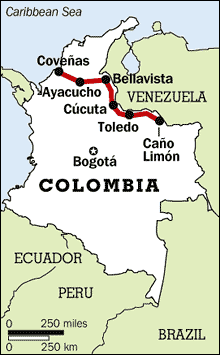
BOGOTÁ, COLOMBIA – In a sign of how important protecting oil has become to the US, 70 Army Green Berets are training Colombian soldiers how to guard a 500-mile stretch of oil pipeline in a lawless portion of the country.
Every drop of oil has taken on new significance for Washington as uncertainty grows in the petroleum-rich Middle East, and a two-month strike in neighboring Venezuela has slowed exports from there.
That means more attention on relatively small producers like Colombia, where the oil potential ranks behind Mexico, Venezuela, and even Brazil, analysts say.
"It's not so much that Colombia is a large oil supplier, or that it is the most important oil supplier," says Amy Jaffe, a senior energy analyst at the James A. Baker Center for Public Policy at Rice University. "It's really more a timing issue."
But US priorities in Colombia, the 10th-largest oil supplier to the US, have been shifting for some time. American troops are now authorized to train Colombian troops to fight rebels rather than just intercept drugs.
Six months ago, Congress authorized $98 million for equipment and troops to help protect the pipeline from guerrilla attacks.
Guarding Caño-Limón is the first step in this new policy, which was designed to help protect infrastructure such as roads and electrical towers from rebel attacks.
Oil "is an increasing priority" in Colombia, says Adam Isacson, an analyst at the Washington-based Center for International Policy, which supports demilitarization of the Colombian conflict. "It could even make the difference in [stabilizing] the price of oil," he says.
But first, the political situation must be stabilized in the violence-ridden state of Arauca, where the majority of rebel attacks against the pipeline occur. Arauca has seen four car bombs, the murder of 30 people, and the kidnapping of two Western journalists - who were released last week - since the start of 2003.
The mouth of the Caño-Limón complex sits in the middle of the dusty road between Saravena and Arauca City in northeastern Colombia, just six miles from the Venezuelan border.
In 2001, the Revolutionary Armed Forces of Colombia (FARC) and the National Liberation Army (ELN) bombed the pipeline 170 times, stalling production for seven months and causing a loss of $500 million to the Colombian government. In 2002, as Colombian protection grew, rebel attacks decreased, but it is still a prime target.
Occidental Petroleum spokes- man Larry Meriage, calls the arrival of US troops "reassuring." He points to a December explosion outside the Caño-Limón complex that killed two and wounded 11 Colombian Occidental security contractors.
Mr. Meriage says Occidental, which owns a large stake in the Caño-Limón pipeline, is exploring other opportunities in Colombia's upper Magdalena Valley and the central Llanos basin.
Security will come from 70 members of the 7th Special Forces Group based at Fort Bragg, N.C. who arrived in Colombia two weeks ago to train local troops. A US official, who requested anonymity, said he was unaware of any other military unit directly deployed to help protect an oil pipeline.
The American troops will train about 450 Colombian men for eight to 10 weeks in basic infantry skills, intelligence, and rapid- response to rebel threats.
Of the $88 million that is certain to be used for what is known as the "infrastructure security program," US officials said $71 million would be provided for badly needed helicopters - the pipeline brigade currently has none - and $17 million for actual training programs.
The same official said that once training of a battalion had been completed, another Special-Forces unit would move in and begin schooling a second Colombian unit. The goal is to train about 900 Colombian soldiers by the end of 2003.
Colombian troops have a pragmatic view of the American presence. "The United States is interested in oil the same way it interests any other country in the world," says Maj. Julio Burgos of the 18th Brigade. "There is a US company that has its interests in this country. The US is defending its interests."
Analysts say maintaining the flow in Colombia contributes to political stability in the region. Michelle Foss, an energy specialist at the University of Houston, suggests that American involvement in protecting the pipeline had to do with geopolitical interests in South and Central America, which depend more heavily on Colombian oil.